Insights
Tools IconJoinery, not carpentry: what an in-house workshop changes
Most of what a client remembers touching in a finished space was made in a joinery shop. Whether the contractor owns that shop decides the lead time, the tolerance and who answers when a door does not shut.
 Tools Icon
3 min read
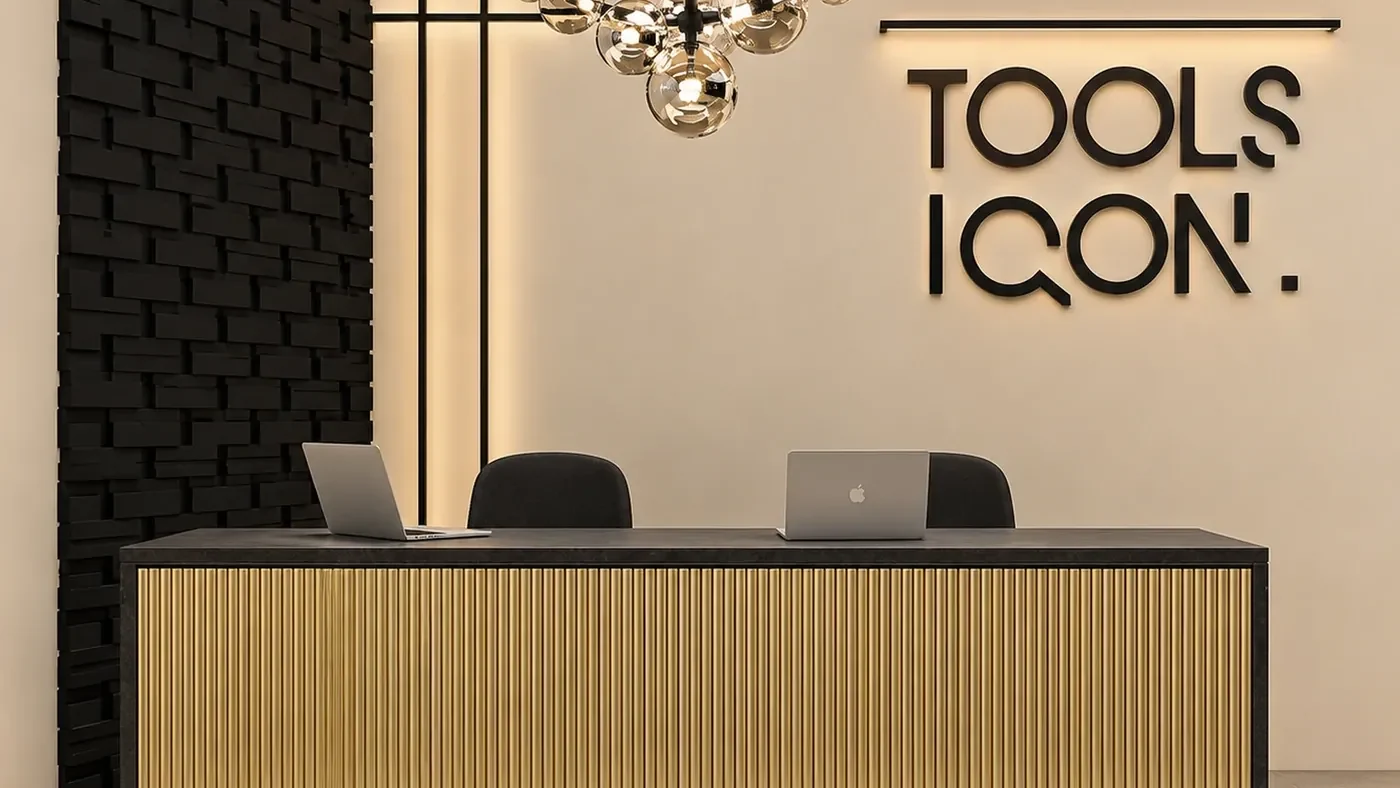
Walk into a finished reception and list what your hand actually touches: the desk, the door, the handle, the wardrobe, the counter edge, the panelling behind the logo. Almost all of it is joinery. It is the single largest line in most fit-out budgets after mechanical and electrical, and it is the line most likely to decide whether the handover date holds.
It is also the part of the trade with the loosest vocabulary. Carpentry and joinery are used interchangeably in tender documents, and they are not the same thing.
Carpentry, joinery, millwork
Carpentry is work cut and assembled on site: studwork, formwork, framing, first fix. Joinery is work made in a workshop to a drawing and delivered finished: doors and frames, wardrobes, reception desks, wall panelling, counters, fitted furniture. Millwork is the same thing under an American name.
The distinction matters commercially, not academically. Site carpentry is paid for in labour and absorbs small errors as it goes. Joinery is paid for in a manufactured product that either fits the opening or does not. A wardrobe made 8mm too wide is not adjusted on site; it goes back to the shop.
Why the workshop decides the programme
Joinery has the longest lead time of anything in a fit-out, because it cannot start until the site is measured, and the site cannot be measured until the walls are up and true. That puts the whole package on the critical path near the end of the job, exactly when there is no float left.
A contractor who subcontracts joinery is queuing in someone else's workshop, behind someone else's project, with someone else's priorities. A contractor who owns the workshop is scheduling its own machine time. On a tight programme that difference is usually two to four weeks, and it arrives at the point in the job where two to four weeks costs the most.
It also changes what happens when something is wrong. An in-house shop remakes a door in three days and absorbs it. An external supplier issues a variation and a new lead time.
Board, veneer and edge — where quality actually lives
Three specification decisions account for most of the visible difference between good and poor joinery:
- The substrate. MDF, plywood and chipboard behave differently under load, in humidity and at a fixing point. In a kitchen or a washroom, moisture-resistant board is not an upgrade, it is the minimum.
- The surface. Real wood veneer has to be sequence-matched across adjacent doors or the grain jumps at every joint. High-pressure laminate does not have that problem and is tougher; it simply is not wood. Decide which you are buying and write it down.
- The edge. Edge banding is where cheap joinery fails first. A 0.4mm edge lifts within a year on a surface people lean on. A 2mm edge, or a laser-applied one with no visible glue line, does not.
Ask for samples of all three before the order, not photographs. A veneer sample under the actual lighting of the space is a five-minute test that settles an argument you would otherwise have at handover.
Tolerance, and why site measurement is not optional
Joinery is made to millimetres and buildings are built to centimetres. The gap between those two is bridged by a site survey taken after the blockwork and plaster are finished, by the people who will make the piece. Any joinery ordered from drawings alone, before the walls exist, carries a scribe allowance — and if the wall is out by more than that allowance, something is coming off the back of the unit on site with a router, which is exactly the finish you were trying to avoid.
What to ask a contractor about joinery
Four questions: Where is the workshop, and can I visit it? Who takes the site dimensions, and at what stage? What is the fixed lead time from approved shop drawings to delivery? And what is the warranty on hinges, runners and handles, which fail long before the box does?
The workshop visit is the one that tells you most. A shop with edge-banding and panel-saw capacity, dust extraction and a finishing area is a different proposition from a shed with hand tools, whatever the two quotations say.
Our joinery is made in our own factory, to our own drawings, on the same contract as the rest of the work — see what the scope covers and what it has produced. If costs are the question first, read what a commercial fit-out actually costs, or send us your drawings.
Read next
All articles
4 min read
What a construction company in Saudi Arabia should show you
Before the portfolio and before the price, there are six documents. A contractor who can produce all six within a working day…
Read article
3 min read
How to choose a fit-out contractor in Saudi Arabia
Seven checks that separate a contractor who will finish your space from one who will finish your budget.
Read article
3 min read
Design-build or traditional tender: which one suits your fit-out
One contract or two? The honest trade-off is between price certainty you get early and price certainty you get late.
Read articlePlanning a fit-out in Saudi Arabia?
We join at design stage and hand over a finished space — joinery, MEP and finishes under one line of accountability.